by Parker Chatham

Stephen and Timothy Quay are identical twin filmmakers whose work expands across animation, live-action, and set design. Their most well-known work is their stop-motion animated films that center on puppets that exist in surreal worlds. On the surface these films appear to be strange and unsettling, but on a deeper level, these films represent the twins’ interest in the metaphysical aspects of life and the secret lives of puppets and automata. The twins’ various inspirations in the spheres of art, literature, film, and performance make their films thematically complex and multi-layered. These films are also collages, both physically in terms of materials (i.e. scrap and found objects) and in content (inspirational sources). Both the material and the content are both carefully curated together to form a single, cinematic experience. This essay will investigate the Brothers Quay’s film-making process by uncovering the underlying themes of their work, their inspirational sources, the historical context they exist in, and finally, their cinematic language. The Quay brother’s film The Comb (1991) will serve as a case study in which to see these influences.
The Quays are known to create experimental stop-motion short films and features that have complex themes and tend to depict puppets existing in unsettling worlds. To the viewer who is unfamiliar to their work, the Quay’s films may easily be found as macabre, grotesque, nightmarish, and alienating. But as avid scholar on the Quays Suzanne Buchan argues, the Quay’s films represent an interwoven “tapestry” of ideas from a multitude of sources ranging from Franz Kafka to Polish poster art (Buchan 10). To understand the way the Quay Brothers’ select ideas into their film is to traverse an overwhelming “labyrinth of artists, playwrights, and filmmakers” (Buchan 10). The Quays identify themselves as “authentic trappers”, seeking out material that is historically elusive and hidden in “[the] archive, the flea market, the used book seller, the antique shop, the library…” (Buchan 8). These materials include the Prinzehorn collection, used and abandoned dolls, antique medical equipment, and illegible micrograms by Walser (Guldemond 5). In an interview with the European Graduate School, one of the brothers describes their intense fascination with objects:
“[We] don’t manufacture things. We tend to find objects, but you also discover something in these objects – a history – and it is that history that appeals to us” (2007).
The Quay brothers have a unique ability to tap into the secret lives of the puppets they animate. What is the life of these puppets defies easy definition. As Buchan argues, the puppets in the Quay’s films neither perform a human soul nor are they simply animistic (33). Instead, as Buchan describes, the puppets have a “nonhuman, non-vegetable, non-anthropomorphic form of vitalist spirit via a cinematic transmutation of matter” (33). The vitalist spirit is an idea borne from the Vitalist movement, which was a movement against materialism and mechanism in the 18th and 19th centuries. During this time, the Romantics were intensely interested in the creation of life, the mysterious of nature, and rejected the cold, objective science of the Enlightenment Era (De Klerk 5). In the same vein, the puppets in the Quay’s film possess a mysterious life force, as if the energy of its past owner or creator lies somewhere beneath its outer shell. Through animation, these puppets are given a variety of gestures and attitudes, all expressions of their inner life-force. It is important to note too that the Quay brothers utilize little to no face replacement animation for their puppets. They instead rely on the preexisting material and its mannerisms for their work. This can vary from a metal screw to a rigged puppet. The human touch is what gives the material its varieties of expression. According to one of the Quays, physically working with one’s hands is the “most humbling part” of the animation process (European 2007). It allows one to leave an imprint of one’s interaction with the medium.
By animating these materials that were previously ignored or forgotten, the Quay brothers create films that illuminate a dark side to existence. In the Quay’s brothers’ 1986 film Street of Crocodiles, a puppet navigates a nightmarish world where dust and grungy buildings pervade; tailors package organs and mannequins vibrate within glass cages. Based loosely on a book of the same title, the film contains references to the real and fantastic event apparent in Bruno Schulz’s stories. In another film, The Comb, a mechanical puppet travels through a labyrinthine playhouse that represents the inner psyche of a sleeping woman. Distorted voices murmur from an attic somewhere and the doll uses ladders to climb to higher ground. The Quay brothers imbued the setting in this film with a feeling of mystery and tension, like that of an approaching nightmare. However, there is no clear monster or gore that would make this a typical nightmare. Instead, it is the buildup of the music together with the surrealistic set design that makes the world of this film uneasy. The collage of different materials such as the wood grain for the landscape and the broccolini stems heighten the realism of the setting. By choosing these materials, the Brothers Quay’s creates a fantastical, nightmarish world that hinges on being real as our own.
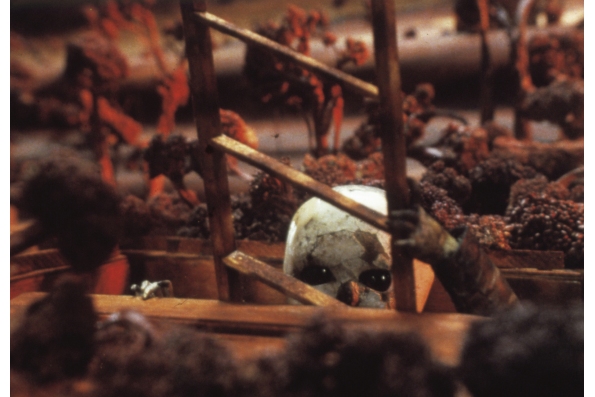
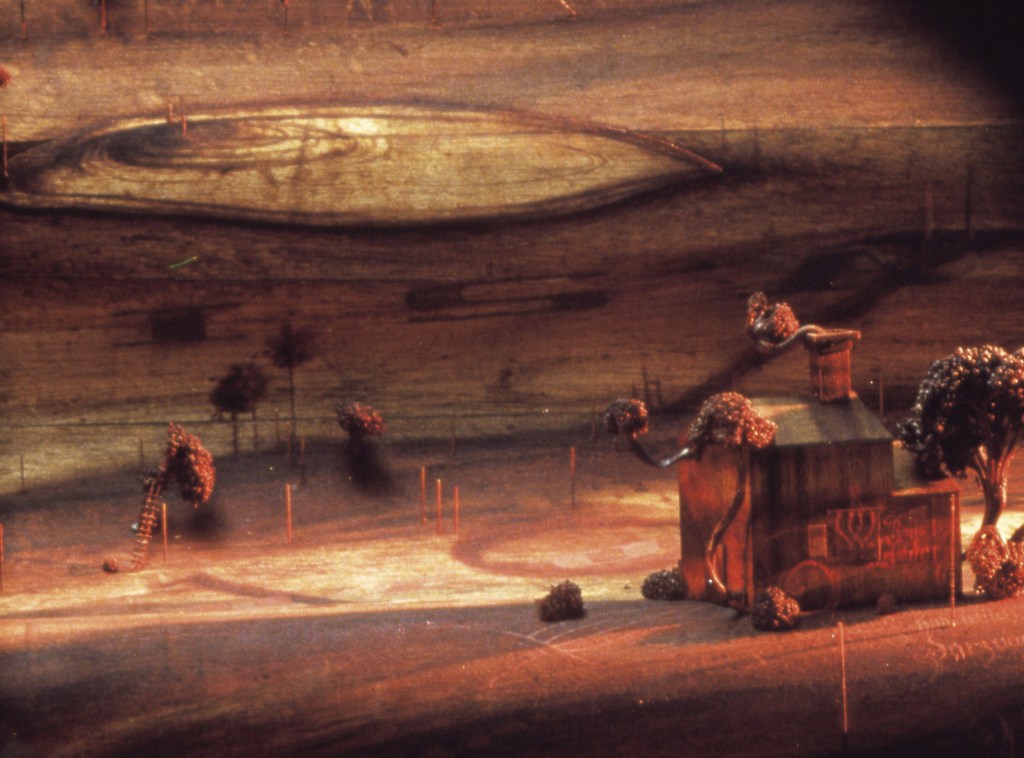
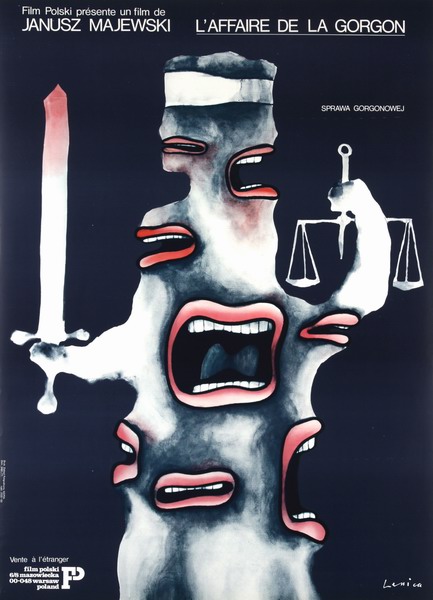
After uncovering the themes that drive the brother’s work, it is important to address the many influences that fuel the brother’s ideas. Along with being artists, the Quays have always regarded themselves as documentary filmmakers and in their exhibition at MoMA in 2012, they were adamant in including the many works of the artists, filmmakers, and animators who influenced them. In the beginning of their careers, the Quay brothers studied and worked in illustration, designing cover pages for magazines and studying at the Philadelphia College of Art. There at the College of Art, the twins were exposed to an exhibition of Polish prints for operas and films which deeply inspired them to research European culture. Print artists and animators Walerian Borowczyk and Jan Lenica deeply inspired the Quays for their print’s bold styles, two-dimensional cutouts, erotic undertones, and use of collage (Buchan 7). Eventually, the brothers were eager to introduce movement into their illustrations, which led them into the world of live-action and animation. Film-makers Luis Bunuel, Andrei Tarkovsky, and Sergei Paradjanov and Eastern European animators Walerian Borowczyk, Jan Lenica, Jerzy Kucia and Alexandre Alexeieff all informed the Quays of anti-narrative structures, experimental film-making, and the use of lighting for chiaroscuro effect (Buchan 7). Writers also influenced the themes of the Quay’s films which included Bruno Schulz, Franz Kafka, and Robert Walser. These writers often focused on the themes of human existence and subjective experience (Buchan 10).
In Quay’s The Comb, we can see these various influences at play. The film is loosely based on a text from Walser’s Essay On Freedom (1928). In this essay, Walser aligns freedom closely with the expression of oneself, whether is it “playing squeamish”, “acting sensitive”, and “frequent dreaming in the night” (1928). Dreams, according to Walser, are a place where one can experience freedom and assume a persona that can be wildly different from one’s identity. Dreams, however, are a force to be reckoned with; the freedom one enjoys in dreams can mock and intimidate the dreamer, reminding oneself of the “beautiful delusion” of being free (Walser). These ideas about the inner psyche and ideas of freedom in dreams resonate in The Comb. In the film, ladders represent a mode of transportation for the puppet. Throughout the labyrinthine dream world, many ladders allow the puppet higher to an unknown destination. However, a foreboding draped figure rocks the ladders, which eventually makes the puppet fall. The mysterious figure appears as an authoritative force, which in light of Walser’s writing, may represent freedom in itself.
Visually, there are many references in The Comb that point to the influences mentioned above. For example, the film’s frequent use of rim lighting can be seen in Alexandre Alezeieff and Claire Parker’s Night on Bald Mountain (1933).

After investigating the themes and inspirations that permeate in their works, it is important to see how these various elements coalesce together into the Quay’s distinctive cinematic language. Through editing, music, and lighting; the Quays create a narrative that has an underlying dream logic and that utilizes a new unique approach for making films. According to Buchan, the Quays “construct a spatial logic of direct connections between discontinuous spaces, creating a distinctively unique cinematic realm” (138). One of their influences, cinematographer and film director Andrei Tarkovsky extensively employs this technique in his surrealistic film Stalker (1979). This idea of creating relationships between two different places to create a narrative can be seen in The Comb, where the puppet’s twitching actions in the dream world are repeated as the woman’s hands twitched in the live-action realm. Through this relationship, the audience can decipher that the puppet represents the dreamer or the nightmare, or perhaps both. Additionally, the music informs much of the twin filmmakers’ decisions. According to an interview with Ish Klein, the Quay’s remarked that they always begin production with a completed music score (The University of the Arts – Philadelphia 2009). In The Comb, the puppet climbs and arranges the ladder to the rhythm of the music. When the sharp strings and erratic horns intensify to a discordant cacophony, this is matched graphically to the puppet falling from the ladder and the dreamer awakening. With music, the Quays were able to create relationships with not only among images but also among sounds. Finally, lighting is a large element in the Quay’s films. The influence of Alexandre Alexeieff and the Impressionism movement in art informed the Quay’s of the ways in which to light gloomy scenes with transitory light. The golden afternoon glow in The Comb can be seen in many of the Impressionist paintings.
In conclusion, after looking at the poetics of the Quays, their sources of inspiration, and their cinematic language, this paper has taken a closer look into the Quay Brothers style of filmmaking. Their belief in staying true to the original material of the object and giving life to it through stop-motion is an invaluable lesson to contemporary filmmakers interested in stop motion. Furthermore, their meticulous execution in music and lighting, as well as set design, exemplifies how the marriage of all three elements can effectively tell a story. Their visual language and film-making have undoubtedly influenced future animators including me. Being an identical twin with a background in stop-motion, I appreciate their craftsmanship and found inspiration in their work.
Works Cited
Brooke, M. (2007). Stories of the eye… Quay Brothers. Vertigo, iii(4), 34–35. Retrieved from http://search.proquest.com/docview/1746206542/
Buchan, S. (2011). The Quay Brothers into a metaphysical playroom . Minneapolis [Minn: University of Minnesota Press.
[European Graduate School Video Lectures] (March 14, 2007) Quay Brothers. The Concept of Film and Animation. Retrieved from https://www.youtube.com/watch?v=0iLklzo9gAA
Quay, T., Quay, S., Buchan, S., Guldemond, J., & Bloemheuvel, M. (2013). The Quay brothers’ Universum . Amsterdam: EYE Filmmuseum.
[Raffi Asdourian] (August 12, 2012) The Quay Brothers Interview. Retrieved from https://www.youtube.com/watch?v=xuW-RchDq2Q
Walser, Robert. The Walk. Trans. Middleton Christopher and others. London. John Calder Publishers. 1957. Print.
 Site Title